Acupuncture · Herbal Medicine · Cupping

Quiet, careful care for the whole of you.

Acupoint Wellness Clinic is a small Chinese medicine practice on East Main Street in Ventura. Every visit is one on one with your practitioner, and every treatment is built around how you feel that day.

Tue · Thu · Sat9 am to 6 pm961 E Main St, Ventura
Acupoint emblem: a lotus with an acupuncture needle and a leafy branch
Our approach

Medicine that starts by listening.

Chinese medicine looks for the pattern behind a symptom. Two people with the same headache may leave with very different treatments, because the cause is rarely the same.

Pulse and tongue

Each visit begins with a conversation, then a reading of your pulse at both wrists and a look at your tongue. These are the oldest diagnostic tools in the tradition, and they still guide every point we choose.

One plan, many tools

Needles, cups, herbs, ear seeds and hands-on bodywork are parts of one system. We combine them when it helps and leave them out when it doesn't.

Unhurried time

A first visit runs 90 minutes and a follow-up 50. There is room to ask questions, rest with the needles in, and talk through what comes next.

Treatments

Five practices, one tradition.

Each can be booked on its own. Prices are for self-pay visits.

针灸 · zhēn jiǔ

Acupuncture

Book acupuncture

Eases pain, settles the nervous system, and helps the body find its balance again.

Acupuncture does more than quiet a sore spot. In the language of Chinese medicine it opens the channels and restores balance. In everyday terms, what feels tight, scattered or stuck starts to settle. Many people say the first thing they notice is not that the pain has gone, but that their whole body has let go.

The story

Long before metal needles, people pressed and scraped the body with shaped stones called bian. Metalworking brought the Nine Needles, nine forms for different depths and conditions, and the third-century Zhenjiu Jiayi Jing turned practice into a system that could be taught from a book. Today acupuncture is practiced in well over a hundred countries and is recognized by UNESCO as part of humanity's intangible cultural heritage.

What a session is like

After your pulse and tongue are read, a small number of sterile, single-use needles, each about as fine as a hair, are placed and you rest for 20 to 30 minutes. Most people feel a dull, heavy warmth at a point rather than pain, and many fall asleep.

Who it suits

Ongoing neck, shoulder, back or leg painRecurring headachesPoor sleepStress and tensionConstant tirednessUnsettled digestionTests look fine, but something feels offWellness maintenanceSeasonal tune-ups
拔罐 · bá guàn

Cupping

Book cupping

Loosens stiff, heavy muscles and brings an immediate sense of release.

Gentle suction lifts the skin and the layer of tissue beneath it, drawing fresh circulation into an area that has been tight for too long. For shoulders and backs that ache from desk work, or stiffen after a chill, cupping often gives the quickest feeling of something finally opening up.

The story

The earliest surviving record is a Han dynasty silk manuscript, the Fifty-Two Prescriptions, which describes drawing on the skin with a hollowed animal horn. Bamboo cups replaced horn in the Tang dynasty, and the name "fire cup" was fixed in the Qing. The tools have changed from horn to glass. The principle has not changed in two thousand years.

What a session is like

Cups are placed on the back, shoulders or legs and left for several minutes. The feeling is a firm pull, like a massage in reverse. Round marks are common and painless, and usually fade within a few days to a week.

Who it suits

Desk-worn shoulders and backDeep soreness after exerciseMuscles that tighten in the coldThe heavy, achy start of a coldA body that feels tight all overRecovery between workouts
中药 · zhōng yào

Customized herbal formula

Book a consultation

Works from the inside, on the patterns that needles and hands cannot reach.

A formula is written for a person, not for a symptom. It asks why you tire sooner than others, why stress goes straight to your sleep, or why you run hot and cold at once. The aim is to move your body from a state that keeps producing problems back to a steadier baseline.

The story

The idea of a composed formula was already present in the Huangdi Neijing. Around 200 CE, Zhang Zhongjing's Shanghan Zabing Lun set out the method still used today: identify the pattern, then treat it. Each formula is a small team. A chief herb leads, a deputy supports it, an assistant tempers it, and an envoy guides it where it needs to go.

What a session is like

After a pulse and tongue assessment, your practitioner writes a formula for your pattern and adjusts it at follow-ups as you change. Please tell us about any medications, supplements and allergies, and whether you are pregnant or breastfeeding, so the formula is safe for you.

Who it suits

Ongoing fatigueLight, restless sleepWeak digestionIrregular cyclesCatching every seasonal coldLong-term issues that keep returningBuilding long-term resilience
耳穴 · ěr xué

Ear seeds

Book ear seeds

A gentle, needle-free treatment that keeps working for days after you leave.

A tiny seed taped to a point on the ear gives steady, light stimulation around the clock. It is the easiest way to carry the calming effect of a visit home with you, and a good choice for anyone who would rather avoid needles.

The story

The Huangdi Neijing describes the ear as the place where the channels gather, and families in the Ming and Qing dynasties taped mustard seeds and mung beans to the ear for sleeplessness and pain. Chinese medicine pictures the ear as an inverted body, with every region mapped onto it. The traditional seed comes from the vaccaria plant, wang bu liu xing.

What a session is like

Seeds or small metal beads are placed on a few points of the outer ear. You press them gently a few times a day, and remove them at home after three to seven days.

Who it suits

Trouble sleepingStress and worrySupport between visits for painUnsettled stomachNeck and shoulder tensionAnyone uneasy about needlesBusy schedules between visits
推拿 · tuī ná

Therapeutic massage

Book massage

Opens what is stuck, so your body can move freely again.

This is treatment by hand, and it differs from a relaxation massage. Working along the channels as well as the muscles and joints, it lowers muscle tone, frees tissue that has become bound, and improves local circulation. You feel the change as it happens.

The story

Pressing a sore place with the hand is the oldest medicine there is. The Huangdi Neijing lists it among the main treatments for muscles and channels, and the Sui and Tang courts appointed official masters of massage to teach it. In the Ming dynasty the older name anmo, press and rub, gave way to tui na, push and grasp.

What a session is like

Pressure is set to your comfort, from gentle to deep. Let us know about injuries or areas to avoid before we begin.

Who it suits

Stiff neck and shouldersLower back strainJoints that have lost rangeTension headachesStiffness from long hours sittingThose who prefer hands-on treatmentRelaxation and wellness maintenance
Areas of focus

Where our work is concentrated.

These are offered alongside your medical care, never in place of it. We will always tell you plainly what acupuncture can and cannot be expected to do.

Pain management

For pain that outlasts the original injury, or never had a clear one. Treatment is layered: acupuncture or electroacupuncture to calm how pain is processed, with cupping or massage to release the muscle guarding that keeps it going.

Recurring neck, shoulder and low-back pain, widespread pain, lingering pain after surgery, tension headaches.

Stroke recovery

Zhu's Scalp Acupuncture places fine needles just beneath the scalp, over the regions of the brain that govern movement and speech. It is used alongside your rehabilitation program as one more input for recovery. Progress is often gradual.

Movement difficulties after stroke, support for speech and swallowing recovery, a plateau in rehabilitation.

Sleep, stress and anxiety

For people whose tests are fine but who are constantly tense, sleep lightly and tire easily. Acupuncture and ear seeds work on the nervous system directly, and massage releases tension held in the neck, shoulders and chest.

Long-term stress and burnout, restless sleep, anxiety felt in the body, mood changes around menopause.

Fertility support

The goal is to support you and your fertility team, with attention to stress, sleep and comfort around retrieval and transfer. Research on acupuncture during IVF is encouraging but mixed, and no treatment can promise a pregnancy.

Preparing for or going through IVF or IUI, repeated cycles, fertility-related anxiety.

Advanced training

Zhu's Scalp Acupuncture

A named system developed by Dr. Ming Qing Zhu over decades of clinical work. It combines traditional theory with modern knowledge of how the brain is organized, using defined treatment zones on the scalp and longer needle retention. It is the foundation of our stroke recovery and neurological work.

Advanced training

Mei Zen Cosmetic Acupuncture

A structured protocol for the face and neck developed by Martha Lucas, Ph.D., L.Ac. Very fine needles are placed in precise patterns to encourage the skin's own renewal and improve muscle tone, with no injectables and no downtime. Many people find it deeply relaxing as well.

Your practitioners

Two practitioners, one tradition of care.

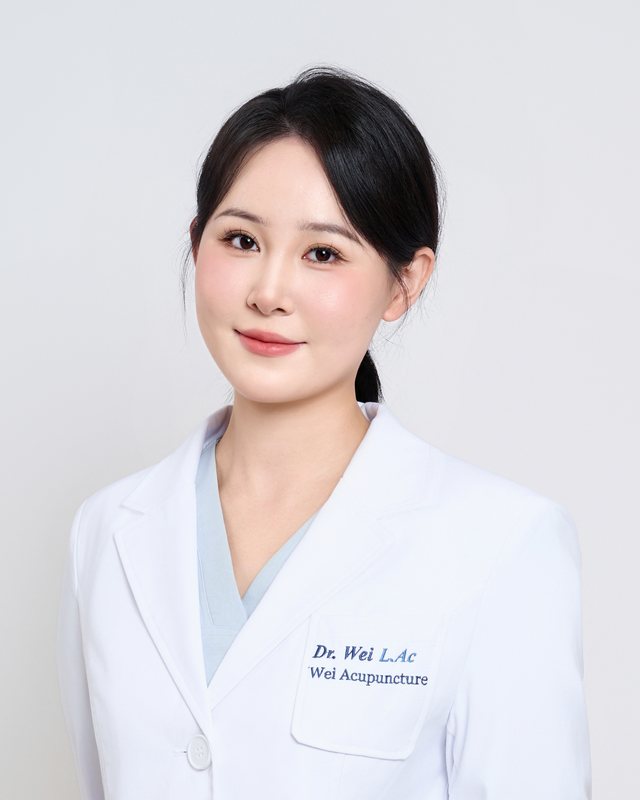
Dr. Elizabeth Wei in a white coat

Dr. Elizabeth Wei

L.Ac., DAHM · Doctor of Acupuncture and Herbal Medicine
California Licensed Acupuncturist

Dr. Wei grew up surrounded by Chinese medicine. Her grandmother and great-aunt were both doctors of Chinese medicine, and her mother studied it from childhood. Raised in the United States, she absorbed that tradition at home while developing a lifelong love of drawing and art. The same eye for detail and balance shapes every treatment she gives today, cosmetic acupuncture included. She is a graduate of UC Berkeley.

During the COVID-19 pandemic she was drawn to acupuncture and to how much Chinese medicine can offer across a wide range of health conditions. She earned her Master of Acupuncture and Herbal Medicine at Alhambra Medical University, and trained closely with Dr. Jiongshi Chen, L.Ac., OMD, at CNH Acupuncture & Herbs Clinic until his passing.

After her master's degree she spent a year in clinical training in acupuncture and women's health at Nanjing Hospital of Chinese Medicine in China. She then returned to Los Angeles to practice and completed her Doctor of Acupuncture and Herbal Medicine.

Her advanced training includes Mei Zen Cosmetic Acupuncture with Martha Lucas, Ph.D., L.Ac., and Zhu's Scalp Acupuncture, the system developed by Dr. Ming Qing Zhu, with Dr. Ru Shan Shi and Dr. Sheng Chun Chang.

Pain managementStroke recoverySleepStress and anxietyFertility support

Dr. Wei speaks Mandarin and English.

Jian Mundahl

L.Ac. · California Licensed Acupuncturist
Licensed Massage Therapist

Jian comes from three generations of Chinese medicine practitioners. She grew up in China inside that family tradition, learning the medicine first as a way of daily life and only later as a profession. That early grounding still shows in her work, which is patient, practical and attentive to the whole person.

Her clinical experience was built in some of Jiangsu's best-known hospitals. She worked and trained at Jiangsu Province Hospital of Chinese Medicine, at Drum Tower Hospital, and in maternal and child health care, seeing a wide range of patients and conditions in busy hospital departments.

She later studied under Dr. Jiongshi Chen, L.Ac., OMD, and is a California Licensed Acupuncturist. She is also a licensed massage therapist, so needles and hands-on work come together naturally in her treatments.

Jian is especially skilled in customized herbal medicine, cupping and tui na. Patients often come to her for a formula written carefully around their own constitution, or for bodywork that reaches tension other treatments have not.

Customized herbal medicineCuppingTui na massageAcupuncture
Your first visit

What to expect.

Before you arrive

Book online and complete your intake forms in the patient portal, or arrive 15 minutes early to fill them in. Eat something light beforehand and wear loose, comfortable clothing.

In the room

We talk through your health history and what brought you in, then read your pulse and tongue. Your first acupuncture treatment follows, with cupping or bodywork added if it suits.

Afterwards

We agree on a treatment plan that fits your goals and schedule. Drink water, take the rest of the day gently, and notice how you sleep that night.

Book and visit

Choose a time that suits you.

Appointments are booked through our secure patient portal. You can pick a treatment, see open times, and reschedule or cancel up to 24 hours before your visit.

HoursTuesday, Thursday, Saturday · 9 am to 6 pm
Address961 E Main St, Ventura, CA 93001